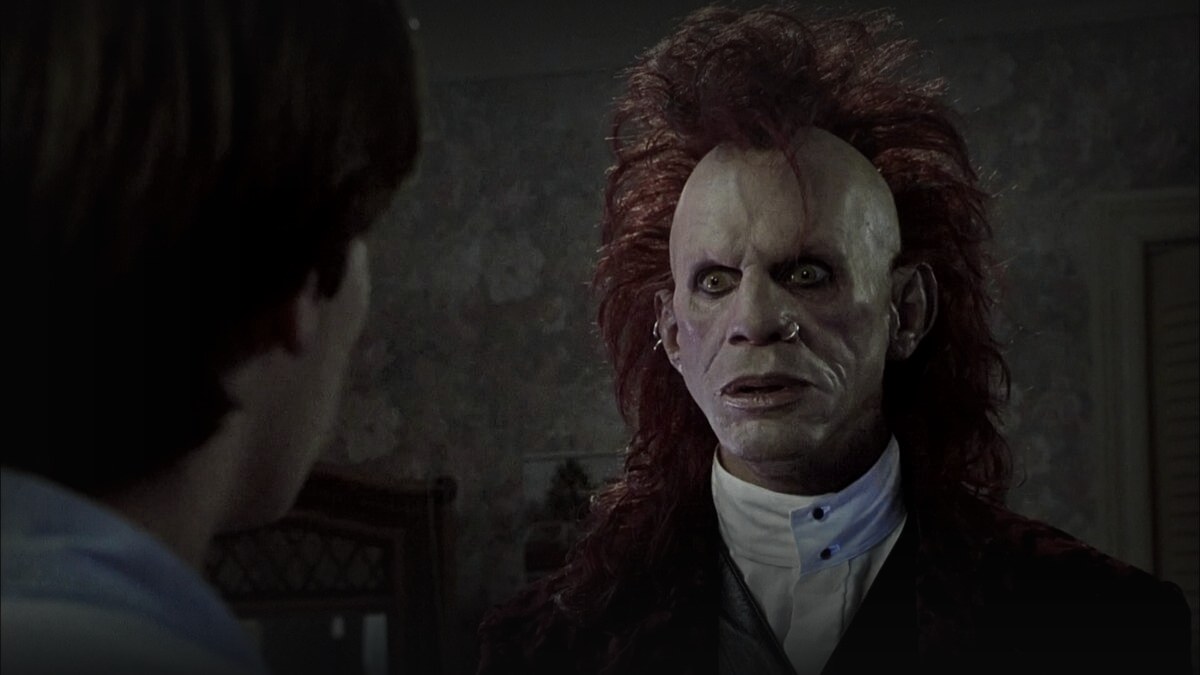
Brainscan (1994)
A 1994 science fiction slasher film directed by John Flynn from a screenplay by Andrew Kevin Walker, the man who would write Seven the following year. The film stars Edward Furlong as Michael Brower, a troubled teenage horror and video game obsessive who receives an interactive cd-rom game in the mail and discovers that the murders he commits inside the game happen in the real world. Frank Langella plays Detective Hayden, and T. Ryder Smith plays the Trickster, the game’s grinning host.
The film opened in april 1994 through Triumph Films to mostly negative reviews, then found its audience on vhs and cable. It is now remembered as a period piece, a time capsule of the exact moment virtual reality and interactive games entered the culture and every parent in america got scared of the computer.
What the film does
Michael Brower lives alone in his absent father’s house. A car accident killed his mother and left him with a limp, and he fills the empty rooms with horror movies, video games, and his telescope trained on the bedroom window of Kimberly, the girl next door he cannot talk to. His only friend is Kyle, the other misfit in the school’s horror club. Kyle tells him about a new game, something called Brainscan, interactive and ultra realistic. The first disc arrives in the mail without a return address.
The game greets Michael with a warning that the experience is like hypnosis, and then the Trickster appears: a cadaverous, alice-cooper-like host who walks him through the first mission, which is to murder a stranger and take a foot as a trophy. Michael plays it, thrilled. Then he reads the morning paper and sees the murder he committed in the game, in his town, down to the details.
Kyle begs to play, Michael refuses, and the Trickster starts showing up in the real world. The second mission is to kill a possible witness. Michael resists, plays anyway, and wakes with no memory of it, to find Kyle’s necklace in his freezer. The phone call to Kyle is answered by Detective Hayden. The Trickster gives Michael one final mission: kill Kimberly.
Michael sneaks into Kimberly’s room and cannot do it. The Trickster reveals himself as the worst part of Michael’s own mind and possesses him. Their struggle wakes Kimberly, who has been watching him right back through her own camera, and her seeing him breaks the hold. Then the Trickster opens the door, and Detective Hayden shoots Michael dead. Michael wakes in his own room. It was the game, all of it. Kyle is alive. Nobody died. Michael, shaken and strangely confident, goes to Kimberly’s house and asks her out. She says yes. The last shot is Michael handing the disc to his principal, and the Trickster grinning at the camera from across the street.
Why it’s in the canon
Criteria blend is 1+3, loved it and want to remember it. Brainscan is the purest mid-90s horror artifact in the canon: a slasher built on cd-roms, interactive video games, and the national panic about what the computer was doing to teenagers. The script was written in 1987 around a vhs tape, then rewritten to ride the virtual reality wave, and the film shows its seams in the best way. Every piece of technology in it is now an antique, and the movie has aged into something closer to a museum piece than a thriller, which is exactly why it belongs here.
T. Ryder Smith’s Trickster is the film’s center of gravity. He is the game made flesh: a dead-eyed, grinning stage actor in a black duster, walking Michael through missions with the patience of a customer service rep from hell. Flynn said later that the Trickster was the whole reason he took the film, and it shows. The character is the rare horror villain who is literally software, a product, and the film never stops to explain him, which makes him stick in the head for years.
Edward Furlong is the other half of the film’s appeal. Post t2, pre american history x, he plays Michael as a kid who is adrift: lonely, angry, barely out of bed, staring at a girl through a telescope instead of walking over and saying hello. The film never pretends he is a monster, which is what makes the premise work. Langella, slumming beautifully as Detective Hayden, gets the film’s best deadpan, and the soundtrack is a period-perfect mix of white zombie, primus, mudhoney, tad, pitchshifter, and the butthole surfers, with a score by George S. Clinton.
The film was shot in montreal in the summer of 1993 and released the next april, where it was roundly dismissed: 13 percent on rotten tomatoes, a d from entertainment weekly. Columbia TriStar put it on vhs that november and it found its people. It is the early-90s game-panic movie with the best monster, and criterion 4 is earned in one sentence: no other film of the video-game moral panic wave gives the game itself a face, a voice, and a wardrobe.
A note on the image
The hero image is the film’s most circulated still: the trickster, in his red-haired ghoul form, confronting michael. It is served by letterboxd as a 1200x675 crop and is the same image as tmdb’s top-voted backdrop for the film, so the two primary sources converge on the same still. The source is a dark interior, baked at brightness 0.80 with the standard desaturation and edge fades to output brightness 26.0, inside the night-scene range.
On hand
Yes, dvd.
image: 16:9 still from letterboxd (the film's top-voted tmdb backdrop, served as a 1200x675 crop), baked in-process at brightness 0.80 with the standard desaturation and edge fades, output brightness 26.0